


Hot Keyword:
Author:KUNYUAN Machine ManufacturerTIME:2026-08-27
Practical machine answer
A hand-knit pattern can sometimes inspire an industrial circular-knit fabric, but it cannot usually be transferred stitch for stitch. The design must be re-engineered for the machine's needle beds, selection actions, repeat size, yarn feeds and continuous production direction, then proven through sampling.
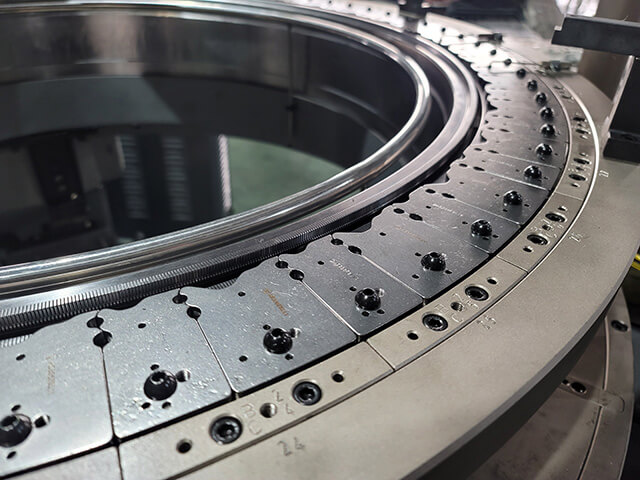
Hand patterns may use turning rows, manual shaping, cables, increases, decreases or assembled panels. A conventional circular fabric machine normally makes continuous courses at a fixed needle count. The developer therefore studies the visual face, stretch, thickness and reverse side, then decides which machine actions can approximate those properties.
Knit, tuck and miss selection can reproduce many textures and color motifs. Double-knit beds expand structural options, and electronic jacquard improves individual needle control. True hand-worked shaping or complex stitch transfer may still require a different machine class, garment linking, cut-and-sew construction or a redesigned motif. Naming that boundary saves repeated failed samples.
Begin with a swatch and a technical sketch that marks the important features. Build a small repeat, choose yarns suitable for the gauge, knit greige fabric and inspect both sides. After finishing, compare scale, handle, recovery and distortion with the design intent. Revise one variable at a time and archive the accepted file, yarn map and settings.
| Original feature | Industrial development question |
|---|---|
| Cable or relief | Can knit/tuck/miss actions create a stable equivalent? |
| Color motif | Does the repeat fit needle and feeder selection? |
| Shaped panel | Will shaping occur by cutting, sewing or another machine? |
| Hand yarn | Is an industrial package available in a runnable count? |
Practical limit: Judge conversion by the required appearance and performance after finishing, not by whether the industrial knitting sequence resembles the hand instructions.

 Tel: +86-13859034518
 Email: info@kunyuanmachine.com
 MP/WhatsApp: +86-13859034518
 Manufacturer Address:Bacuo Village, Yonghe Town, Jinjiang City, Fujian Province