

Hot Keyword:
Author:KUNYUAN Machine Manufacturer TIME:2026-08-28
A machine brochure can state diameter, feeders and maximum speed. A production planner still needs a different number: accepted kilograms per scheduled hour for one fabric, yarn set, quality limit and operator pattern. The gap between those two views is where realistic capacity planning begins.
Selected RPM, active feeds and the structure being knitted. This describes the operating point, not saleable output.
Kilograms produced while the machine is actually knitting, including material that may later be held or rejected.
Inspected kilograms released from the scheduled hours after stops, setup, sampling and quality loss.
Mixing these figures produces optimistic quotations and confused performance reviews. Record all three, with their time base. A supplier example may be useful for comparing machine configurations, but it should not be copied into a mill plan unless fabric weight, width, structure, efficiency and finishing state match.
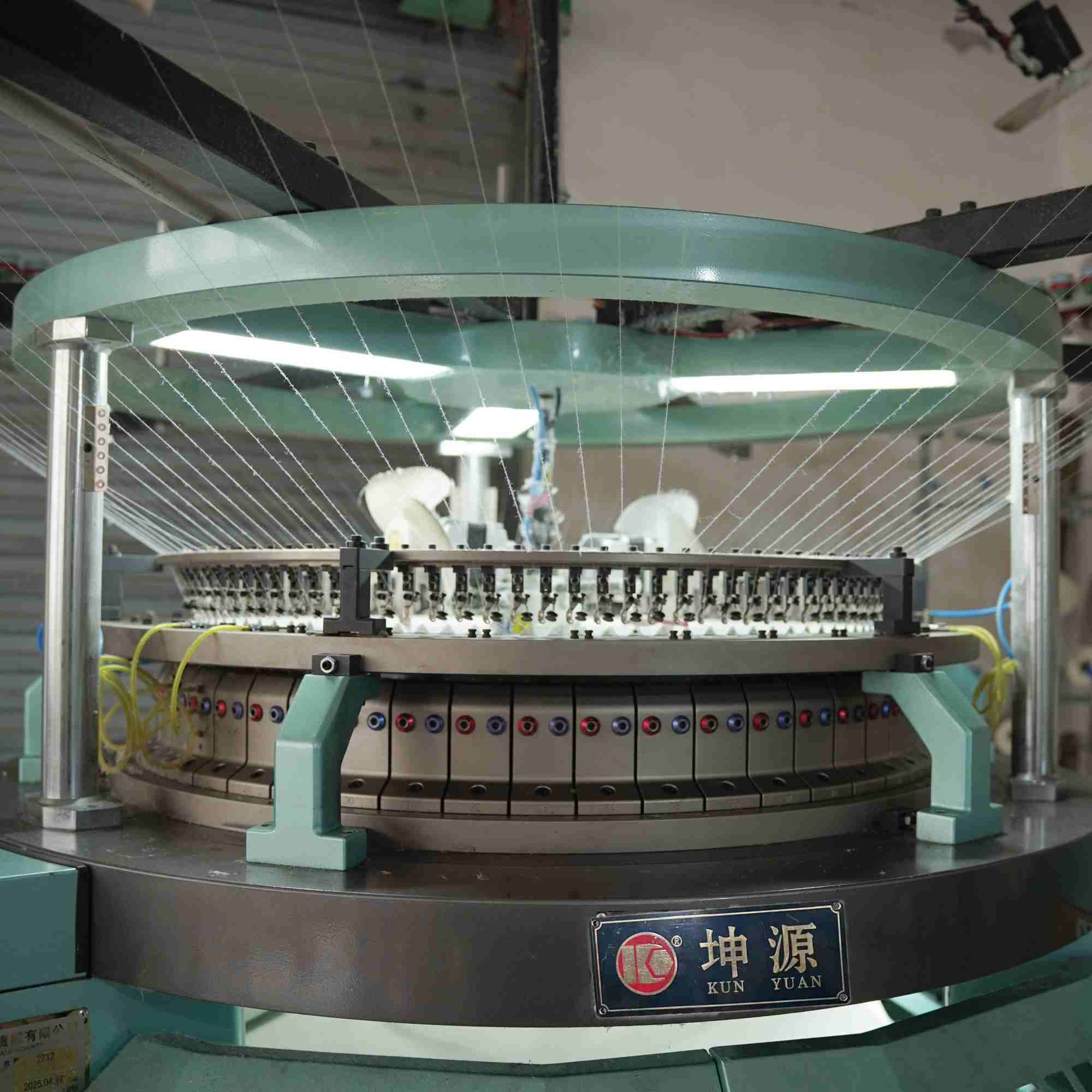
For a plain multi-feed route, rotations per minute multiplied by active knitting feeds gives a useful course-formation rate. It does not by itself give kilograms per hour. Patterning, inactive feeds, plating, stop motions, yarn limits and the chosen fabric setting can reduce the practical relationship. Two machines at the same RPM can produce different cloth because their usable feed count and fabric program differ.
Machine limits also vary by diameter and model. An official Mayer & Cie. example for a 32-inch single-jersey machine reports production using a stated efficiency, RPM, gauge, fabric weight and structure rather than speed alone. Treat that format—not the example number—as the useful lesson: every capacity claim needs its assumptions beside it.
When finished or relaxed fabric width and linear output are known, a transparent mass check is: kilograms = linear metres × usable width in metres × GSM ÷ 1,000. For tubular fabric, state whether width means lay-flat width or opened width and keep that convention through the calculation. If the mill records only roll weight, use weighed roll output over a measured knitting interval instead of inventing a linear speed.
Here is a shift example that needs no brochure assumption. A machine is scheduled for 420 minutes and knits for 350 minutes, so running efficiency is 83.3%. It produces 160 kg before inspection; 8 kg is held, leaving 152 accepted kg. Accepted production is therefore 21.7 kg per scheduled hour. Running output was 27.4 kg per knitting hour. Both numbers are correct, but they answer different questions.
| Measure | Formula or source | Why it matters | Common mistake |
|---|---|---|---|
| Course reference | Selected RPM × active feeds for the stated plain route | Compares operating points | Treating it as kg/h |
| Running efficiency | Knitting minutes ÷ scheduled minutes | Shows time loss | Removing setup and cleaning from the denominator |
| Gross running kg/h | Weighed output ÷ knitting hours | Describes conversion while running | Calling it shift capacity |
| Accepted kg/scheduled h | Released weight ÷ scheduled hours | Supports labor and delivery planning | Ignoring held fabric |
One efficiency percentage hides the reasons capacity changes. Split scheduled minutes into setup, planned cleaning, yarn changes, stop-motion response, element replacement, quality adjustment and waiting time. Split non-released weight into setup cloth, inspected hold, repairable downgrade and reject. The categories should be few enough for operators to use consistently.
Compare losses by fabric code, not only by machine. A demanding plating route may have a lower stable speed than plain jersey yet produce more valuable accepted cloth. Increasing RPM while stops and held weight rise can lower accepted output. The planner should look for the operating range where speed, fabric quality and intervention rate settle together.
Begin after the machine has reached a stable condition with the approved yarn, needles, settings and take-down. Identify the yarn lot, structure, nominal GSM, width convention and finishing state. Record scheduled start and finish, actual knitting minutes, selected RPM, active feeds, gross roll weight, held weight and accepted weight.
Repeat the trial across more than one roll and normal shift changes. A short demonstration can miss cleaning, creeling and intervention losses. If the result will support a purchase decision, ask the supplier to state the offered machine configuration and run a fabric trial using the buyer's yarn or an agreed equivalent. The related circular knitting machine overview can frame that discussion, while the signed trial sheet should carry the final capacity basis.
After installation, keep the same worksheet for ramp-up. The useful trend is not whether every shift reaches one target; it is whether accepted output improves without a rise in repeat defects, stops or maintenance exceptions.
Only in a simplified comparison where every other condition stays stable. In production, yarn behavior, stops, quality limits and take-down can change as speed rises.
Active feeds influence course formation, but the usable number depends on the structure and machine setup. Feed count must be stated with the fabric route.
Use the unit that matches the production decision, and retain enough width, GSM and roll data to reconcile the two when possible.
Do not borrow a universal percentage. Measure a representative trial and separate scheduled time, actual knitting time and quality loss.
Not by itself. Delivery planning should use accepted kilograms per scheduled hour plus a documented allowance for style changes and normal variability.
Circular knitting machine capacity is credible when another planner can reproduce it from the shift record. RPM and feeders describe an operating point; weighed output, scheduled time and quality release describe the business result. Keeping those layers separate turns a brochure number into a usable production commitment.

 Tel: +86-13859034518
 Email: info@kunyuanmachine.com
 MP/WhatsApp: +86-13859034518
 Manufacturer Address:Bacuo Village, Yonghe Town, Jinjiang City, Fujian Province