

Hot Keyword:
Author:KUNYUAN Machine Manufacturer TIME:2026-08-28
The old article confused an industrial small-diameter circular machine with a hobby spool knitter. A useful replacement starts from the manufacturing route: some products need a stable continuous tube, some need body-size zones or separation, and others are only feedstock for cutting, linking, coating or assembly.
Lay out the finished item, an opened construction sample and the greige tube if available. Mark knitting direction, circumference changes, ends, seams, cut lines, stretch and all downstream operations. The supplier should be able to point to each requirement in the proposed machine or make-up scope.
Avoid forcing every product onto one route merely because its diameter appears similar. Gauge, needle count, bed arrangement, electronic selection, feeds and take-down decide what can be formed repeatably. The size table and boundary samples decide whether that capability is commercially useful.
For sleeves, liners or components cut from a tube, define circumference tolerance, usable length, wale alignment, spirality, end waste and the method used to separate pieces. State whether the final product is greige, dyed, coated, bonded or sewn.
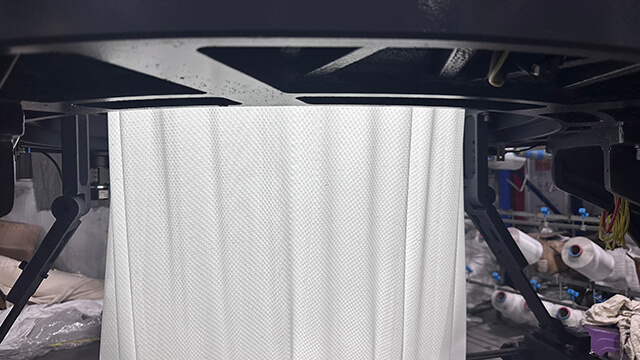
Measure at several roll positions because tension and take-down drift can create a tube that passes near the start and fails later. Include roll build and downstream cutting yield in the output figure.
If the machine produces individual pieces or programmed zones, record the separation yarn or mechanism, finished length, welt or opening, and every size-specific file. Identify remaining cuts and seams so a partially complete piece is not marketed as finished.
Run boundary sizes with production yarn. Preserve program revision and the measured garment or component after relaxation, because recovery can shift both length and zone position.
Time cutting, linking, sewing, closing, washing, blocking, coating and inspection on the same sample family. Add labour skills, tooling and work-in-process limits. Fast knitting cannot improve delivery if a manual join remains the bottleneck.
Define responsibility for defects that appear after assembly. A marked greige sample and operation card help separate tube variation from cutting distortion, seam tension or finishing shrinkage.
Choose the smallest circumference, longest piece, heaviest yarn, most complex zone or strictest tolerance from the sales plan. Record accepted output, stops, waste, make-up time and final dimensions.
List which products share the approved cylinder, needles and program environment, and which require a conversion or another platform. A written exclusion is safer than an informal promise that a future style should also work.
| Route | Knitting output | Next operation | Final acceptance |
|---|---|---|---|
| Continuous tube | Length and circumference by roll position | Cut, join, coat or assemble | Usable yield and dimensional tolerance |
| Separated piece | Programmed length, zone and end | Openings, labels or limited seams | Finished size and separation quality |
| Body-size garment | Size-linked program and yarn plan | Wash, block and garment make-up | Zone position, fit and recovery |
| Technical component | Traceable tube lot | Product-specific processing | End-use test owned by named party |
No. The names can be confused online, but their scale, construction, control and applications differ. Identify the exact industrial platform and model.
Cylinder and needle count matter, but yarn, structure, stitch settings, stretch and finishing also affect the finished measurement.
It may have no longitudinal seam, but cutting, closing, openings or assembly can remain. Describe the complete make-up route.
Use accepted final units or usable tube per scheduled hour, with knitting stops, separation or cutting waste and downstream capacity visible.
Test the product boundaries most likely to change configuration or fail tolerance, not only the easiest middle size.
Choosing a small-diameter machine for tube products is mainly a route-design task. Once continuous knitting, separation, shaping and make-up responsibilities are visible, the mill can select a configuration, measure its real bottleneck and release only the product family that the evidence supports.
Compare the route drawing with the small diameter circular knitting machine range and ask the supplier to mark every conversion, make-up operation and boundary sample in the offer.

 Tel: +86-13859034518
 Email: info@kunyuanmachine.com
 MP/WhatsApp: +86-13859034518
 Manufacturer Address:Bacuo Village, Yonghe Town, Jinjiang City, Fujian Province