

Hot Keyword:
Author:KUNYUAN Machine Manufacturer TIME:2026-08-28
Circular knitting needles, sinkers, selectors, cams, guides and electronic devices may look similar while differing in geometry, butt path, finish, revision or position. A useful RFQ begins with the machine record and the failed duty, not a generic part name.
Create a controlled dossier for each request. Include complete machine identity, cylinder or dial reference, gauge, system and feed position, original part documentation, quantity in use, current stock, failure symptom and urgency. Keep photographs as supporting evidence rather than the primary specification.
Separate routine consumables from configuration-critical components. Replacing a needle with an approved equivalent is not the same risk as substituting a cam, selector or control device that changes motion or timing.
Record model, serial or production reference, diameter, gauge, cylinder and dial identities, controller revision where relevant and any verified modification. Identify the physical location using the mill's position convention.
If a nameplate, manual and physical component disagree, stop the RFQ and reconcile the machine before selecting stock. An old purchase history may describe a previous configuration.
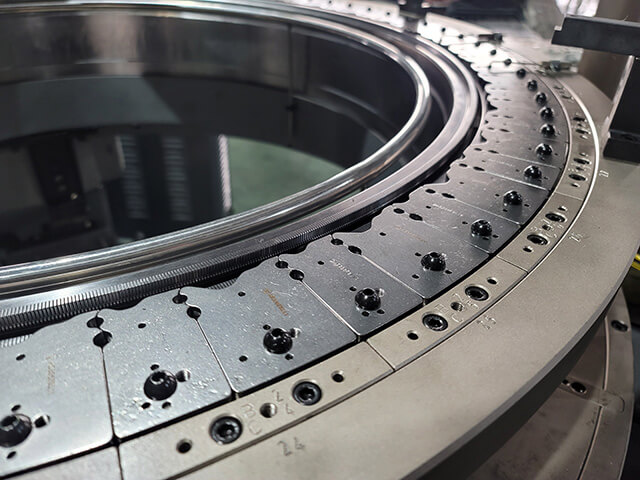
Use the approved maker or supplier reference, part family, bed, butt arrangement, hook or latch form where relevant, finish or coating designation, and packaging identity. Add a clear image with scale only to confirm the referenced object.
Do not publish assumed metallurgy or hardness. Ask the supplier for authoritative compatibility and quality documentation for the exact offered part.
Count affected parts by machine position, lot, running basis and fabric recipe. Describe wear, fracture, latch condition, scoring or deformation at the actual location, then attach the matching fabric mark.
A cluster at one feed or track suggests a different response from evenly distributed end-of-life wear. The RFQ should request corrective support when evidence points beyond the component itself.
Receive parts against documents and packaging, segregate lots and inspect a defined sample. Install only under the approved service procedure, record positions and knit a marked comparison at a controlled condition.
Release the lot after fit, motion, fabric and service evidence pass. A part that enters the slot but damages yarn or moves differently is not compatible.
| RFQ block | Mandatory evidence | Supplier response | Release gate |
|---|---|---|---|
| Machine identity | Model, serial, gauge, installed build | Applies to exact revision | Records agree |
| Part system | Reference, bed and position | Compatibility declaration | No visual assumption |
| Failure pattern | Wear and marked fabric | Cause/support comment | Risk understood |
| Incoming lot | Packaging and sample plan | Traceable batch | Controlled trial passes |
No. Exact cylinder, bed, butt, hook/latch and approved part references are also needed.
Yes, for context and label confirmation, but dimensions and appearance alone cannot establish compatibility.
Use a small controlled incoming trial and defined inspection before broad release.
It helps distinguish normal part consumption from a machine, yarn or setup condition that will damage replacements.
Keep lot identity, installed positions, removed samples and the marked before/after fabric result.
A good spare-parts RFQ eliminates ambiguity before price comparison. Exact machine identity, part system, failure evidence and an incoming trial protect the knitting elements, fabric and inventory from a visual-match purchase.
Attach the compatibility dossier when sourcing parts for the circular knitting machine range and require the supplier to respond against the exact installed system rather than a generic machine family.

 Tel: +86-13859034518
 Email: info@kunyuanmachine.com
 MP/WhatsApp: +86-13859034518
 Manufacturer Address:Bacuo Village, Yonghe Town, Jinjiang City, Fujian Province